
The Parks Commission's 600 Bancroft letter, plus off-leash bikes and bond oversight

Aquatic Park just after sunset. Photo: David Abercrombie, CC BY-SA 2.0 (Wikimedia Commons).
Notes from the November 10 meeting of the Parks, Recreation and Waterfront Commission, as I remember it (agenda).
Whenever I write about the commission, I am speaking in an individual capacity and not representing the Parks, Recreation and Waterfront Commission or the City of Berkeley.
Bikes in the off-leash area
On the off-leash area at Si Se Puede Park, it was pretty straightforward. It sounds like there are some people being jerks. Of course, we only have secondhand information, but I could totally see it.
We don't want to penalize or send the wrong message to cyclists in general. Riding bikes is obviously a legitimate recreational activity. But in the off-leash area, it seems perfectly reasonable to officially propose a ban, and maybe encourage the City to put some signs up. At least then it becomes clearer who's right and who's wrong. I don't think a fence is in any way, shape, or form realistic.
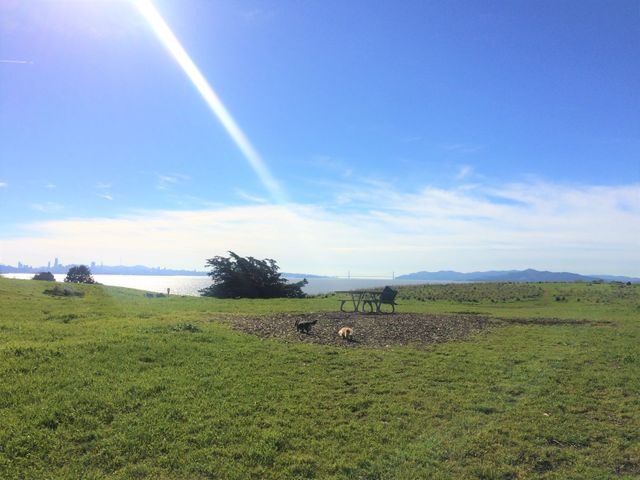
The off-leash meadow at Si Se Puede Park (then César Chávez Park), looking toward the Bay. Photo: TPFUUT, CC BY-SA 4.0 (Wikimedia Commons).
Measure U
On Measure U, it sounds like the City has given review powers or responsibilities to several commissions, and the Parks Commission will have this role for the parks bond items. The draft resolution has the commission reporting to the Council every year on the projects the bonds fund and whether the spending matches the bond's purposes, with recommendations on proposed projects and spending (agenda item 11).
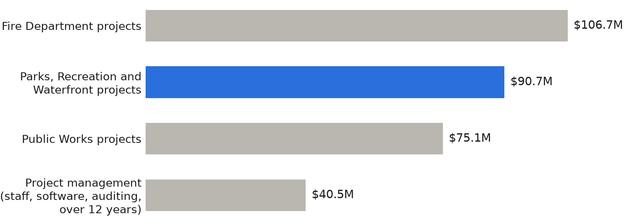
Source: Measure U bond project list, November 10 agenda packet, item 11 (pp. 75-77).
In the brief conversation we had about this, it sounded a little confusing, as these things usually are with the Parks Commission, because it's purely advisory. We're supposed to weigh in on where the funding goes and make recommendations, if any, about changes if necessary. I think the first deadline is sometime in January. On top of that, we're responsible for some kind of annual audit, which is really confusing. Scott Ferris, the Parks director, wasn't really clear on how this is supposed to work. Neither are we, but we'll get into it next year.
My read is that the Council is probably doing this to ease concerns about funding priorities changing quietly, which was a talking point among opponents of the measure during the campaign. It seems to be a theme among folks at the Waterfront, the Cal Sailing Club in particular. You'll sometimes hear them promote the idea that the City is going to take bond money to fund the ferry, which I think is a little paranoid.
600 Bancroft
Overall, my big complaint about the 600 Bancroft letter is that it feels very obstructionist in the way it's worded.
This commission has a bit of a reputation for opposing and obstructing things. Consider the Berkeley Marina Area Specific Plan, now called the Waterfront Specific Plan. This commission's advice was a big part of why its approval was delayed. Maybe I'll do a separate post on this at some point. But what happened there was that in 2024 the commission asked the Council to hold off on the plan until a parking study was done and a plan was added for what was at the time César Chávez Park (memo). The Council agreed (direction), and then the park plan ran into the old landfill's contamination problems (City report). The specific plan was stuck behind it until this summer, when the Council separated the two (item 9).
As usual, though, the full context was more complicated. There are many constituencies at the Marina who fight tooth and nail against any changes. Undoubtedly, they were very happy to see the plan stalled, not because they wanted it to grow broader in scope, but because they don't want it to happen at all. The money ran out too: the Marina is currently insolvent (the City's own October slide is titled "Marina Fund Exhausted – Bailouts Needed to Continue"), and last year the leftover plan money went to dock repairs. The end result is that progress at the Marina was delayed at least another year or two. The City is only now picking the plan back up, and expects to finish it, with its environmental review, in 2027 (City of Berkeley).
I don't think the commission sank the plan. A lot went wrong at once, and most of it wasn't our doing. But these things are delicate. When a commission acts on its own to slow something down, there are consequences, and they're not always the ones anyone intended. Our job is to help the City produce better outcomes for Berkeley residents, and I'd like to see us much more oriented toward how we can help, rather than always criticizing.
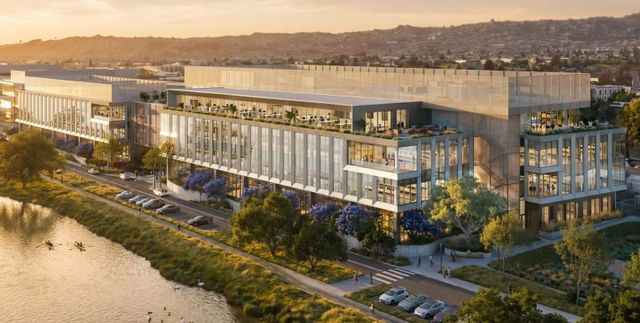
Rendering from the applicant, in the City's Design Review Committee staff report (October 15, 2026).
Now consider 600 Bancroft. There's a development agreement in progress, and it has been for several years. Development agreements like this are a totally normal, standard process. The City works with a developer to find a positive-sum solution: the City gets some major concessions that let it accomplish a major infrastructure project, or generally do something really great for Berkeley residents, and in return the developer gets some variances or special accommodations.
It's important to note these concessions are often really incredible! We're not talking minor little things like a $5,000 donation to a nonprofit. For example, across Bancroft, the Berkeley Commons development at 600 Addison came with a repaved Bolivar Drive and a raised crosswalk, $48,000 a year for ten years toward Aquatic Park maintenance, $2.5 million for the City's housing trust fund, $1.5 million for public art, and more than 75,000 square feet of public space, including a native plant garden (Berkeleyside). That area is so nice now. It's a dramatically improved situation down there.
It's also important to remember that developments like this are enormously beneficial for Berkeley. It's incredibly frustrating to hear some people talk about this project like it's a weapons manufacturing outpost from some intergalactic evil empire, and that there's just nothing beneficial that will come from it. For Christ's sake, we're talking about a roughly 250,000-square-foot research and development building (staff report), most likely biotech. This is very likely to be some kind of life-saving technology. When this commercial space gets filled, it will provide a huge number of high-paying STEM jobs. A huge percentage of those jobs will be supporting families, many of whom will live in Berkeley. This is just an unalloyed good.
And for all the nits about completely subjective design decisions, I like the architecture of the building. I don't really have any objections to it. It will also bring more foot traffic to the area, more eyes on the street, so to speak. Aquatic Park at night is sketchy. Fleshing out the development and having more lighting in this area will just be purely beneficial for residents.
The way the letter was worded, it would be hard for someone reading it to come away with the impression that the commission supports this process at all. The letter insists that, even before any development agreement is negotiated, the developer must conform with the commission's requests. The draft put it this way: until the commission's design concerns are addressed, "negotiations regarding a development agreement are premature" (packet, item 10). The commission doesn't have that power. It just reads like the commission is claiming that power for itself and being a bit confrontational with the City, the development agreement team, and the Council. We had to debate whether to even mention that the City is negotiating a development agreement and that we're supportive of whatever they come up with there.
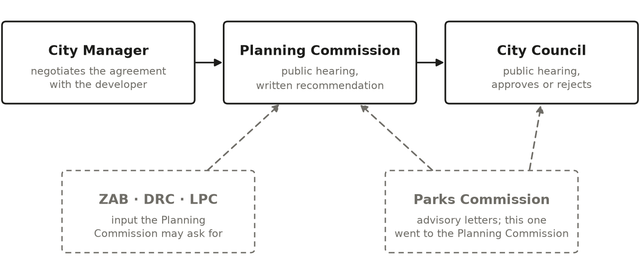
Source: Berkeley Municipal Code 22.16.050.
What's weird about the letter to me is that it's almost like the commission is trying to negotiate with the developer independently. That's just silly. It can't do that. It's counterproductive, and it's a missed opportunity to plug into the process productively.
At one point I asked Scott what he thought about the discussion. He suggested we be a little less rigid with our requests. We don't have all the information, so making really rigid requests or demands is silly: if it comes to light that the project isn't viable with this list of requests as binding conditions, we'd want pre-negotiated mitigations or next-best options. But he wasn't able to convince all the other commissioners that this would have been a good strategy.
The main point of disagreement among commissioners was whether the commission should be weighing in on subjective design questions at all. There were a number of items in the letter originally that were probably better taken up by the Design Review Committee. In fact, I think that's where they came from. I was glad we were able to at least leave those items out. It's perfectly okay for people to have opinions about what the building looks like, but it just doesn't feel like it's in the purview of a Parks Commission to weigh in on that.
In the end, I voted to support some of the requests. I don't want to be a stick in the mud, and I didn't feel like casting a protest vote. But overall, it's very disappointing to me to see the commission take this confrontational, obstructionist, zero-sum approach on these matters.