
What's happening at Dreamland: a bioswale, a playground plan, and a parking shuffle
There's a lot happening at the north end of Aquatic Park, around the Dreamland for Kids playground, and three separate projects meet there. Public Works is building a stormwater garden, a bioretention basin sometimes called a bioswale, paid for by an EPA grant and City stormwater funds. The Parks, Recreation & Waterfront Department has a plan to rebuild Dreamland and the area around it. And a new research and development building is proposed at 600 Bancroft, on the lot just north of the park. The City is reviewing all three under one environmental review, because "the projects are contiguous and the design of these future City projects impacts the R&D's project design and access" (Planning Commission staff report, Oct 7, 2026).
What's there today
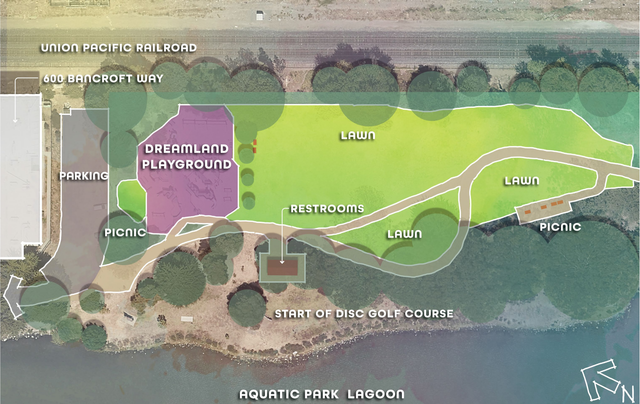
Existing conditions, from the City's October 2024 community meeting.
The Dreamland parking lot is the paved strip between the 600 Bancroft building and the playground, about 50 by 140 feet, or roughly 6,300 square feet. Bolivar Drive dead-ends into it. The lot, the playground and Bolivar are all City land and part of Aquatic Park.
The bioswale
A City storm drain empties into the lagoon right at Dreamland, carrying runoff from a small industrial and commercial watershed east of the railroad tracks. The City's 2019 Green Infrastructure Plan flagged the end of Channing Way at the tracks as a priority site, with 15.8 acres draining to it. Public Works lists the main sources of pollution in that runoff as illegal dumping, light industry, commercial uses and fertilizers.
The basin will sit on the existing parking lot. It's about 8,000 square feet, with a wood boardwalk through it, and it filters runoff through plants and special soil before the water reaches the lagoon. According to the June 2024 Council item accepting the grant, it removes "nutrients, metals, mercury, polychlorinated biphenyls (PCBs), organic compounds, bacteria, and suspended solids," and two trash-capture devices go in upstream on the Bancroft culvert and Channing Way.
The project is required, not optional. The Bay Area's regional stormwater permit (MRP 3.0) requires Berkeley to retrofit 5 acres of paved or roofed area with green infrastructure by June 30, 2027, and the Council item says this project counts toward that mandate. It's paid for with $1.5 million from the EPA's San Francisco Bay Water Quality Improvement Fund, matched by $1.5 million from the City's Clean Storm Fund, and it has to be under construction by 2027. Because it's on park land, Measure L (BMC 6.42.010) also applies: the basin stays part of the park, open to the public via the boardwalk.
The Dreamland plan
The Parks Department ran a community design process in 2024, with a first meeting in October and two concepts in December, and settled on a preferred plan by RRM Design Group in July 2025.
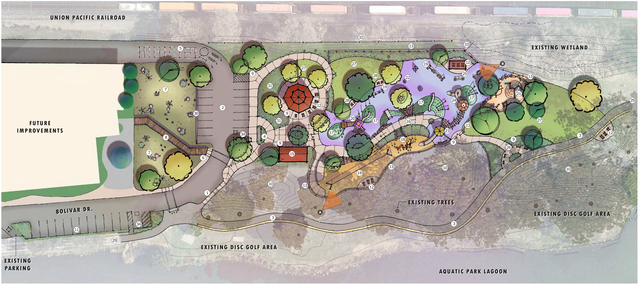
The City's July 2025 preferred conceptual plan (RRM Design Group). The bioretention area is items 7 and 8, the 20-space lot is 2, and head-in parking on Bolivar is 11.
The plan builds the bioswale into the park instead of fencing it off, with educational signage at the boardwalk entrance and a native plant demonstration garden beside it. The rest of the plan is a new playground with a play tower, zipline and nature play, plus a restroom, a group picnic area and lawns. The playground isn't funded yet. The City is looking for grants and other funding, which may include money from the development next door.
What moves where
The bioswale takes the parking lot, so the parking has to go somewhere else, and in both phases it goes onto parts of the park that are unpaved today. First, 12 head-in spaces, one of them ADA-accessible, go along the west side of Bolivar Drive with a crosswalk. Later, a lot of about 20 spaces with a drop-off loop may go in just south of the basin, on what is now the west edge of the playground and picnic area, and the playground shifts east to make room. According to Planning staff at the October 15 Design Review Committee meeting, that lot "will not be constructed until or unless" the 600 Bancroft project moves forward, and the developer pays for it.
What the park gains and gives up
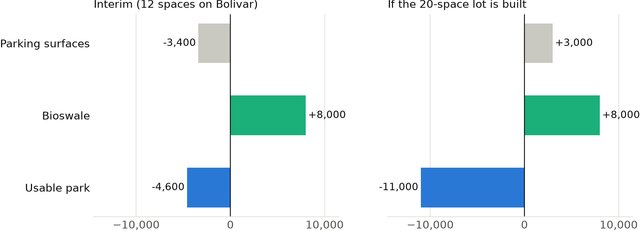
Parking surfaces only; new sidewalks and paths aren't counted. The bioswale is planted, not usable as lawn or play space. Approximate, ±20%.
To be upfront about it: the park loses usable space. The bioswale replaces the asphalt lot, but it's also about 1,700 square feet bigger than the lot, and it's a planted basin you cross on a boardwalk, not somewhere to play or picnic. The parking it displaces then moves onto usable park land. In the interim, with only the Bolivar spaces, the park loses about 4,600 square feet of usable space. If the 20-space lot is built, it loses about 11,000 square feet, roughly a quarter of an acre, most of it at the playground's west edge.
These figures count parking surfaces only, not new sidewalks and paths, so the loss of usable space is, if anything, a little larger. No land leaves the park in any of the plans. I measured these off the City's plan (drawn at 1 inch = 20 feet) and OpenStreetMap, so treat them as approximate, give or take 20%.
Why I like this project
The City had a stormwater mandate and a grant deadline. The obvious version of this project is a fenced basin by the railroad tracks, and that was one of the sites on the table. Instead the City put it on an asphalt lot and made it something people can walk through and learn from, next to a playground, and Parks folded it into a bigger plan for Dreamland. That's a creative piece of work, and the City deserves credit for it.
Open questions
The biggest open question is truck access. The 600 Bancroft proposal would route delivery and emergency access through the park's lot and along Bolivar Drive to a gate at the back of the building, but a 1953 ordinance (BMC 14.56.030) bars commercial vehicles on Bolivar Drive in Aquatic Park. How that gets squared, and how trucks would be kept apart from families, isn't settled. The City is also negotiating a development agreement for 600 Bancroft that could fund Dreamland improvements, but the terms aren't public yet. The environmental document covering all three projects is expected out for public review in January 2027.